Beautiful-looking websites with lots of whizzy stuff going on don’t sell things on their own.
But words do.
If our words are wrong, our message isn’t obvious, and no one will take any notice.
This is an absolute fact of human nature, however much support activity, money or effort you put into design, functionality, SEO, paid ads, etc.
There’s a sizeable chunk of psychology behind why people do or don’t buy, and knowing this will help you communicate better across all mediums and outlets: written, spoken, pitched, presented, in print and online.
The power of words
We’re talking about storytelling, or, in the business sense, story-selling, and it’s got more to do with behavioural science than literary art.
All great stories are about surviving and thriving.
Physical, emotional, spiritual. Being accepted, achieving an aspirational identity, finding love, helping other people. Our brains are always in survive and thrive mode, and the aim of doing business is to satisfy our customers’ need to survive and thrive.
And that is one of the critical mistakes most brands make: they talk about themselves, rather than what will help their customers survive and thrive.
Being in this mode requires the human brain to process huge amounts of information, which is exhausting, so we’re programmed to make efficiencies. Our brains use a story arc as an efficient way to capture and assimilate information, an instinctive way of following a logical trail of information from beginning to end.
Survive and thrive, baby
Story arcs are rooted in biology; they’re part of our conscious programming and form the basic framework of every piece of information you’ve ever processed, not just movies, drama or novels.
As businesses, we need to stop forcing our customers to burn calories telling them about us, and make it easy by telling them a story about them and how their problem will be solved.
What you think you’re saying and what they need are not necessarily the same thing!
Tried and tested by nature
Like all good science, the story arc is based on a formula:
It is a sum of 7 parts:
1. A character
2. Has a problem
3. And meets a guide
4. Who gives them a plan
5. Which calls them to take action
6. That helps them avoid failure
7. And ends in success
This is the archetypal story structure that we recognise in all great tales, from Wuthering Heights to Cinderella, Star Wars, Hunger Games, James Bond, and so on…
A character (who is the hero) wants or needs something badly, but they encounter a problem before they can get it.
When all seems lost, a guide steps in, gives them a plan, and tells them what to do to solve their problem.
The hero follows the plan, which helps them avoid failure and end in success.
1. A character
A character… This is your customer; they are your hero. You, your brand, is not the hero.
(…And a villain) Stories also need villains: good versus evil, justice versus injustice
We typically see villains as people, but they can be inanimate
· The need to avoid paying too much tax
· Being fearful of getting it wrong, being fined
· Having a sense of injustice – I’ve worked hard for this money
2. The hero (your customer) wants or needs something
The hero wants or needs something, and they have a problem.
· What does the hero want or need?
· What or who is stopping the hero from getting what they need?
· What will the hero’s life be like if they do or don’t get what they want?
· What do you offer that will make the hero’s life better?
· What’s the plan to help them achieve that?
· What will that result in, and what will success look like to them?
A hero needs examples:
· Funding the rest of your life beyond work
· Your best ever holiday experience
· The safe home your family deserves
Stating that early on creates story gaps: what the hero wants, how they will get it, will they or won’t they?
Beware cluttering the story
Just a word of caution: your product or service might solve lots of problems, but focus on one at a time, as the hero will have one overarching survive-and-thrive desire or need.
· Conserving financial resources
· Conserving time
· Building social networks
· Gaining status
· Accumulating resources
· Satisfying a need to be generous
· Finding meaning
3. Enter the guide (that’s you)
This is such an important point, and once you understand and accept your role in the story arc, you’ll have a different viewpoint of your customer and your offering:
YOUR CUSTOMER IS THE HERO.
YOU ARE A GUIDE…
Heroes need guides; otherwise, they would solve their own problems, and we know, from stories, that they can’t do that, just like your customers can’t typically manufacture their own televisions, or medicines or car tyres, or do their own legal representations and so on. Your brand is the guide.
Guides need to look outwards to gain trust, so if your web content is inwards looking (a common example is a picture of your building on your home page) you need to turn this around to face outwards by communicating empathy:
· I understand your problem and pain
· Understanding – I know how frustrating it is when…
· Nobody should have to experience…
…and authority
· I have the skills, experience and contacts to solve your problem.
What do all your customers have in common?
They likely have shared values, tastes and problems and people like people, like themselves.
Use testimonials, statistics, awards, and logos of other businesses you’ve worked with and helped.
4. Who gives them a path of hope
The plan. Heroes only trust the guide who gives them a plan that is clear, earns their trust and tells them exactly what they need to do.
When a customer places an order, they are actually saying, ‘I believe that you can help me to solve my problem, so much so that I’m prepared to part with my hard-earned cash’.
But that doesn’t happen instantly, so you have to guide them through the commitment, giving your hero a path of hope so they don’t wander off, not knowing what they have to do.
You have to give your hero a path of hope, step by step:
Example: If you sell garage storage systems, your heroes might ask:
Is it the right one?
Will it do what it says it will?
Will it be difficult to install?
Will it be a waste of money?
So instead, you give them a plan:
1. Measure your space [how to measure your space guide]
2. Choose the items that fit your space from our catalogue [catalogue]
3. When it arrives, follow the enclosed 6-step guide to assemble using the ‘one tool does everything’ provided.
Resource: [printable infographic]
4. Call us if you haven’t managed to build your shelving in 30 minutes or if you’re having problems.
Resource: [phone number]
5. We offer a 28-day no-quibble money-back guarantee.
Resource: [terms and conditions]
6. Press the big ‘make this happen’ button.
Resource: [big red button]
Give your plan a name:
· Easy garage storage installation plan
· A roadmap for your next adventure
· Our 100% customer satisfaction guarantee
· The ultimate small business guide to Making Tax Digital
6. Which calls them to action
Heroes don’t take action unless they are challenged to do so. If we don’t challenge them, they will just watch or wait, not act, and risk being slain, dumped, humiliated, poor, etc…
In real life, people don’t make big decisions without something prompting them:
Changing job/retiring/selling a biz
Going on honeymoon
Hiring a hot-shot lawyer
Most people are bombarded with marketing messages, but exist in a zombie trance unless something challenges them.
Make your Call to Action challenge them…
Direct – buy now/ call today/ do this thing now!
Indirect (transitional – anything that enhances your status as a guide):
Book a free discovery call,
Download/see our free guide, blog article, or webinar
Try our free samples, no-obligation trial period
6. That helps them avoid failure
Everyone wants to avoid a tragic ending. The more that’s at stake, the better the story and the more powerful the resolution will be. If there’s nothing to lose, the story will be boring, no one will care what happens to the hero or even remember the guide’s name (let alone their website URL, phone number, unique selling point, etc)
We keep watching or reading because there’s something at stake for the hero…
It’s the same for your heroes: what’s at stake if they don’t choose you?
It has to be big enough to need you, their guide and your plan:
A Financial Adviser might say, ‘using me will help you to avoid loss in the form of’:
· Worry that you can’t afford to retire
· Confusion about your pension pot
· Lack of transparency about fees
7. The ending we were all hoping for
And ends in success. Never assume people understand how your brand will change their lives; you have to tell them.
· Win power or position (the need for status)
– Create scarcity offer access (loyalty cards)
– Offer premium privileges (flight lounge access)
– Identity access (premium/luxury brand association)
· Be united with someone or something that makes them whole
– Products that offer completeness (reduce anxiety/workload/time-wasting)
– Products that help us to reach our potential
· Inspirational feats – your brand helps inspire people to greater feats
· Self-acceptance: Your brand helps people to accept themselves as they are
· Transcendence: Being part of something for the greater good
And finally…
…close the story loop
Having guided your hero (customer) through their journey, you now have to sell them their own story ending…
Happy, smiley people
Images of people on white beaches
References to grandparents enjoying quality time with their grandchildren
Before and after images of home improvements
So that is how great storytelling can grow your business.
The long-awaited sequel
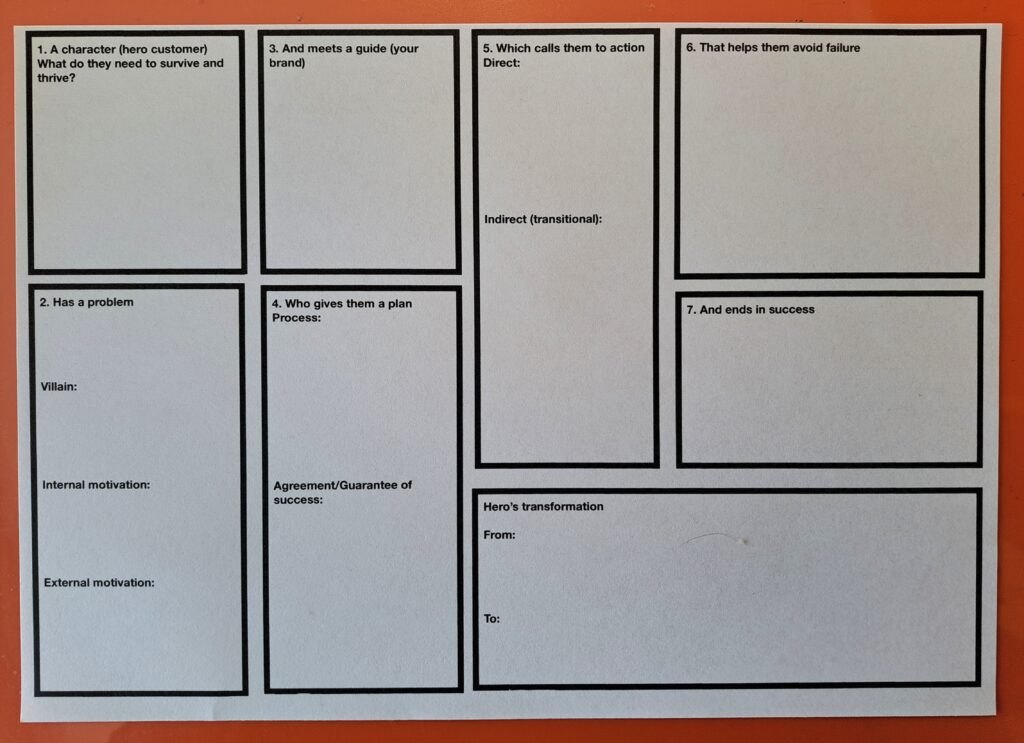
You can do this yourself; in fact, here’s an example story brand grid to start you on your journey.
You’ll have a much better chance of succeeding if you have a guide.
How about the one you’ve already met, who’s a published author and multi-award-winning storyteller…
https//: https://www.whatsitdoodah.co.uk/contact
Further reading: ‘Building A Story Brand’, Donald Miller